
Options are a bit more complicated and can seem daunting compared to “Ye Olde Buy Shares and Holde™”, but the goal of this article is to showcase the power that options can have with active investing.
While they are a bit tricky to understand, the basic functions are quite similar to how shares work, except there’s a few other variables at play.
An options contract represents 100 shares of stock, no matter what price the contract is. The upside to options is that you can control a theoretical 100 shares of stock for much cheaper, with a very high exponential profit zone. The downside is that you have a fairly high probability of the investment going to 0.
The distinction between these contracts is represented with two forms: Calls and Puts.
Of these two forms, they are broken into long calls and short calls, along with long puts and short puts. There are two different styles of options, American and European, with the only distinction being that you can only exercise (buy or sell the shares) European options on the expiration date, whereas you can exercise American style options whenever. Most companies and ETFs on the U.S. exchanges utilize American style options, save for a few.
For this article, we’re going to focus on American style options primarily.
Before we get into it further, we’ll take a look at the makeup of an option contract as it appears on the Unusual Whales Flow page, and how it would read in most places you see it.
A quick breakdown of a long call in the flow.
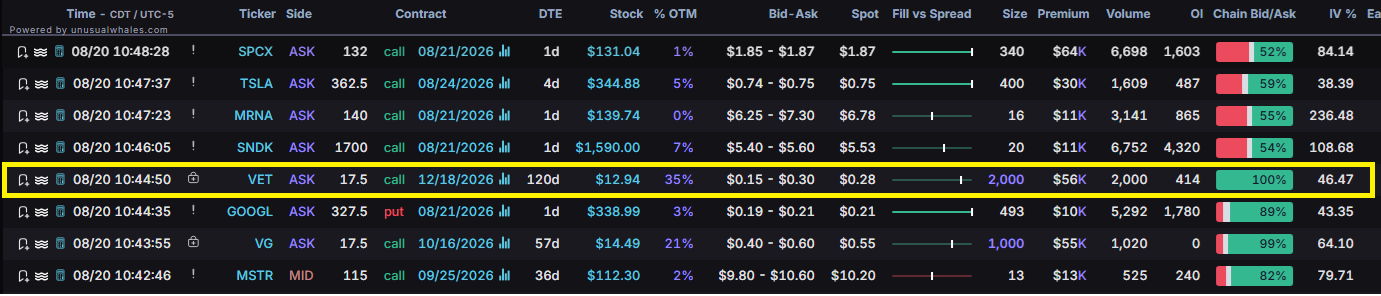
This position would read: VET 17.5C 12/18/2026.
Let’s break this position down to explain each part:
The first part, VET, is the stock “ticker”, an identifying abbreviation, for the company Vermillion Energy. This just tells you what company or stock the contract is for. (For example, the “ticker” for the S&P 500 ETF Trust is SPY).
The second part, 17.5C, actually has two pieces of information. The 17.5 refers to the “strike”, or the price the stock price must reach for this contract to be “in the money”.
The C indicates that this contract is a “Call”. We’ll get into how calls can be traded “long” and “short”, and what those terms mean, a little later.
The last part of this contract, 12/18/2026, is the expiration date of the contract. This is exactly what it sounds like; the last date this contract can be transacted or exist.
At the expiration date of a contract (in this case, December 18th, 2026), there are 3 potential circumstances that can happen for a call contract.
The contract expires in the money, which means the underlying share price’s value is greater than the strike price, or VET > $17.50. This gives you the option to exercise the contract and purchase 100 shares of Vermillion Energy at $17.5 a share. We’ll talk more on exercising later.
You can also sell the contract beforehand, and collect money from the sale. Depending on certain circumstances, which we will get to later, this may either be a gain or a loss. This option is the most common for retail traders like us.
VET shares might be less than $17.50, which means the contract expires worthless, and is then worth $0. Why does it expire worthless? It simply does not make sense to purchase the shares for more than they are worth. If the stock is not $17.50 or higher, this contract would expire worthless on the expiration date.
Now let’s break down the basic of basics by taking a look at Long Calls and Long Puts outright.
Long Calls
Long calls, also known as calls bought to open, are the most similar to buying stock in a company. When the stock goes up, your call should go up in value, too. Long calls have a theoretical infinite upside, so the higher the stock price rises, the more profit can be made on Long calls. That’s what the VET example above outlines.
Below is a Profit and Loss diagram (PnL) for a long call bought at strike A.
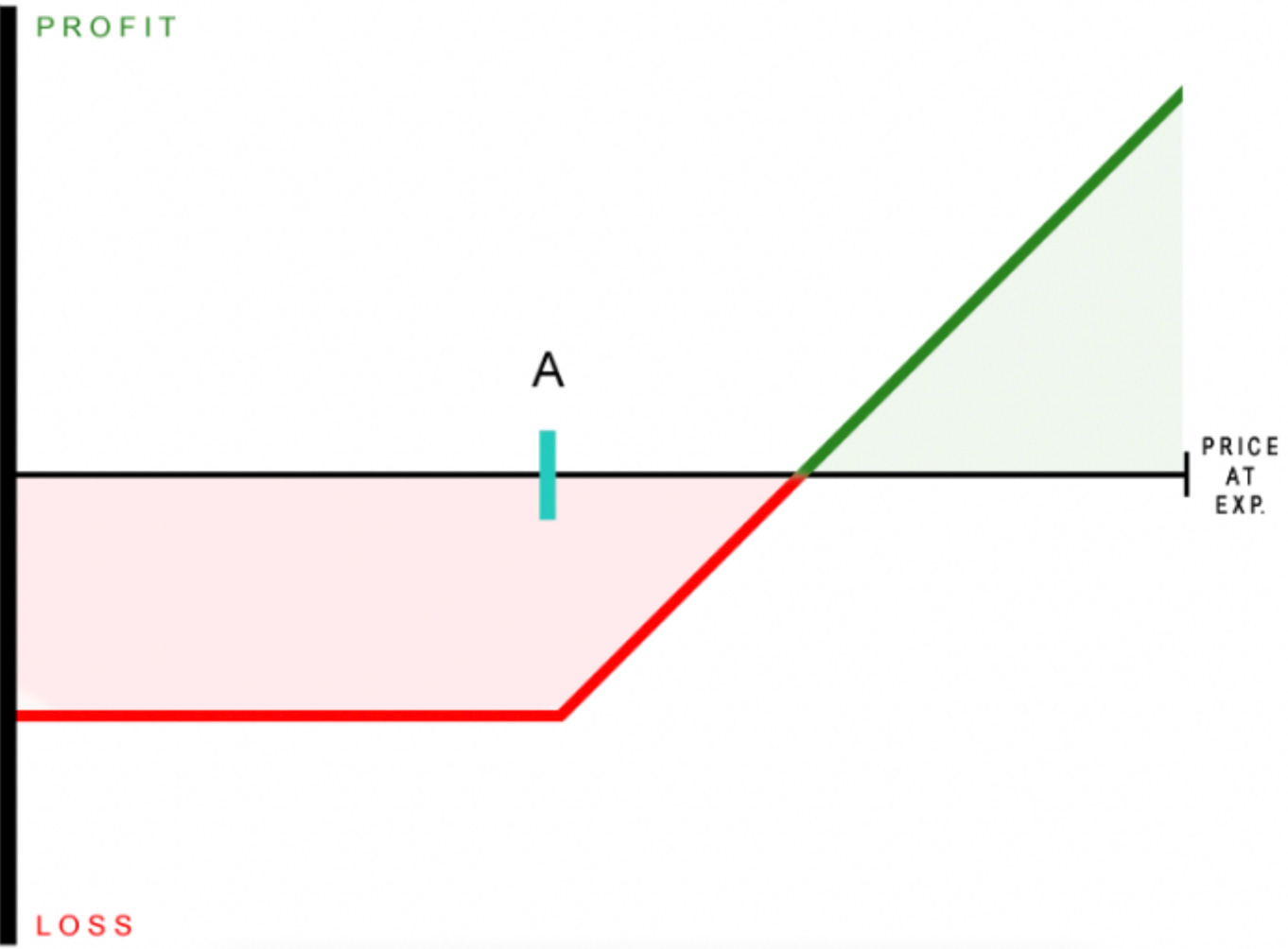
A long call gives the investor the right, but not the obligation, to buy 100 shares/units of the underlying stock/asset at a fixed price, on or before the expiration date of the contract.
What this technical phrase means is that you can exercise the option to purchase 100 shares at any time, even on the expiration date, but you do not have to.
Long Puts
Long puts (puts bought to open) are most similar to shorting stock in a company. When the stock goes down, your put theoretically should go up in value. Long puts have a limited theoretical max gain, as the underlying stock cannot go below $0 per share. However, long puts have the same loss potential of long calls, which is the total value of your initial investment.
Below is a PnL Diagram for a long put purchased at strike A.
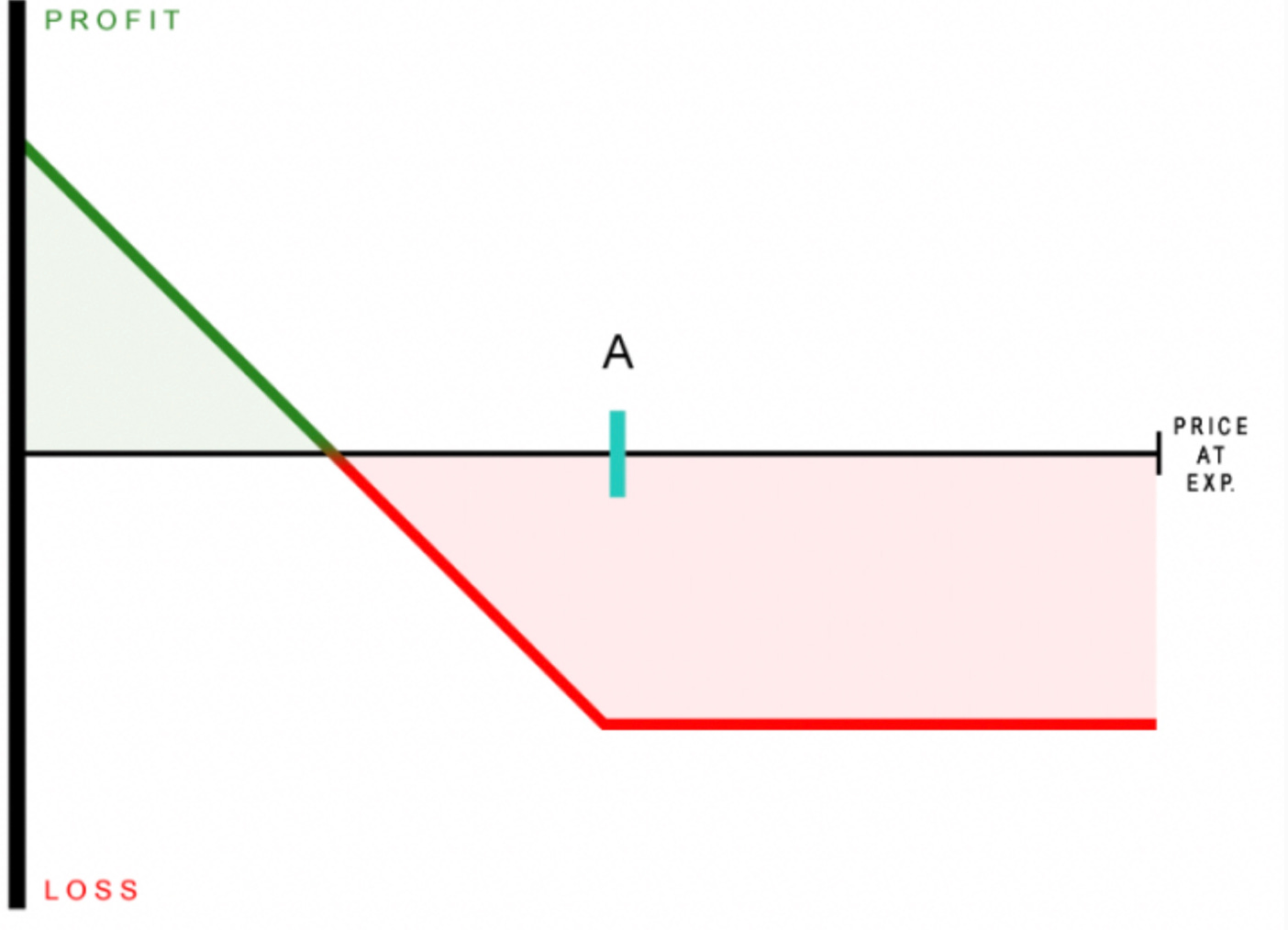
A long put gives the investor the right, but not the obligation, to sell 100 shares/units of the underlying stock/asset at a fixed price, on or before the expiration date of the contract.
Much like long calls, you also have the option to sell 100 shares at any time, including the expiration date, but you do not have to.
A quick breakdown of a long put in the flow.
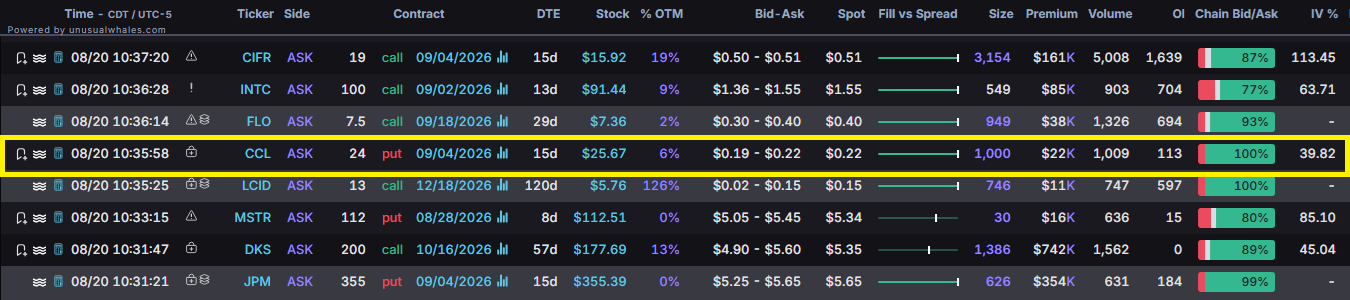
This position would read: CCL 24P 09/04/2026.
Let’s break this position down just as we did the Long Call example above, with a little more context.
Just like the Long Call example, the 24P refers to the “strike” (in this case, $24 for CCL). We can see under the “Bid-Ask” column that the lowest price someone is willing to sell the contract for (the “Ask”) is $0.22, and the highest amount someone is willing to pay for a contract (the “Bid”) is $0.19. Under the “Spot” column (or, the price at which the contract transacted), we see this order of 1,000 contracts for CCL 24P 09/04/2026 transacted at the Ask price of $0.22.
This indicates a higher likelihood that the contracts were Bought (but not, I repeat: not a guarantee they were bought). Another important point to note is that the Size of that order (1,000 contracts) is greater than the Open Interest of the contract (113 contracts) combined with the total volume that same day (9 contracts). This confirms that this position is a newly opened position, because it’s not possible to “close” contracts that don’t exist, and the size of that order is much larger than any existing positions in the contract.
What are the uses?
Both of these descriptions look quite similar, and they are. One makes money when a stock goes up (long call), and the other makes money when a stock goes down (long put).
“But what is a fixed price?”
The fixed price in those descriptions is known as the strike price from earlier
“So how are these prices determined?”
American style options are typically priced by something called a binomial tree, while European options are priced with a model known as Black-Scholes-Merton. These prices are represented per share of the contract, so an options contract that is valued at $1.00 on your brokerage platform is one dollar per share x 100, for the 100 shares the contract controls for a total value of $100. This price is known as the premium.
An example:
For the sake of simplicity, let’s say you have “Generic Manufacturing Corp (GMFC)”, and it’s trading at $100 a share. You see some options flow hit the tape, and you believe that there will be an increased industry demand for GMFC’s main product in the next 3 months. You, as an investor, decide to buy a long call with the strike of $105 for $500 in premium ($5.00 per share x 100 shares) with an expiration in 6 months.
After 3 months, let’s say GMFC is trading at $120, and you are still holding the $105 call. The value of your contract has gone from $5.00 per share to $15.00 per share, for a total of ($15.00-5.00) = $10 x 100 = $1000 in profit.
You’ve made a profit, but you ask yourself “how does this work?”
The value of your long call has theoretically increased by $1000, and you’re presented with a few different options.
Sell the long call for a total profit of $1000.
Exercise the long call, and buy 100 shares of GMFC for 105 a share.
Continue to hold the long call in hopes the stock continues to go up.
Let’s go over each of these scenarios.
Option A
You decide to take your profits, and sell the option for $1500. You receive $1000 in profit from this, since you initially paid $500 for the long call 3 months prior. You are no longer invested in $GMFC, and you can use the money to buy yourself a pizza
Option B
Let’s say you have 3 months remaining on the contract, and $GMFC is trading at $110 per share. Your contract would be worth $1000, or $10.00 per share.
If you choose Option B, you can exercise the contract. This means you can act out the right to buy the 100 shares the contract represents, at $105 per share. The value of such an ordeal would be $10500 that you would pay to obtain the shares. That same amount in shares is worth $11000 if you were to sell, but there’s a catch with it.
The total profit from the option, should you choose to exercise, is calculated as follows:
(Share price x 100) - (Strike price x 100) - (price paid for the contract)
In this case, it would be:
$11000 - $10500 - $500 = 0.
So should you choose to exercise, your total profit would be $0.
If $GMFC is trading at $140 a share, your profit would be:
$14000 - $10500 - $500 = $3000.
Option C
If you choose option C, you would do nothing different. You would continue to hold your long call in the hope manufacturing demand continues to increase, and your contract’s premium continues to gain in value.
In two more months, you would have a month remaining on the contract.
If GMFC is trading at $140 per share, your long call would now be worth $35 per share, or $3500 for the contract. This gives you a profit on the trade of $3000 should you choose to then pursue Option A, and sell the contract. If you notice, this is equivalent to how much you could exercise the option for and then sell the shares.
GMFC could also go down, based on bad news, a poor earnings report, the manufacturing demand decreasing, or a market-wide drawdown. Say you didn’t pursue Option A, and now $GMFC is trading at $110 per share. The value of your contract would then be back at $5.00 per share, or $500.
“But how did the stock go up and I haven’t made money on the position?”
This is due to an effect known as time decay, or time value (often represented by the Greek “Theta”). Time value is represented by how much excess money an investor is willing to pay in hopes that $GMFC’s share price, and in turn, the option’s value, increases before the contract expires in 1 month.
Regardless, you’re back to break even, your options contract is worth $500 after 5 months, and you can look at the options discussed above again and reposition for your next decision.
This is more or less how an options trade unfolds. There are a lot of risks surrounding options, but that doesn’t necessarily mean that they’re scary and should be avoided.
In a future article, we’ll talk more about the risks, along with short calls, short puts, and some other terminology. Trading is all about managing risk, and options are very much a mechanism for doing that.
Thank you as always for reading! REMEMBER!! You can find articles like this and MANY others about Options and the Unusual Whales Platform on the new Information Hub!!
And don’t forget: If you want to see how traders use Unusual Whales tools in real-time, Nicholas hosts a LIVE trading show called WhaleWatch every Monday and Wednesday morning at market open! From taking live futures trades using attributed Market Maker Gamma Exposure with Unusual Whales Periscope, to options flow reads and breakdowns.
You can watch on X, YouTube, or Twitch. The full schedule can be found here: https://unusualwhales.com/officehours
NOTE: This post is not financial advice. The stock market is risky, and any trade or investment is expected to have some, or total, loss. Please do research before any trade. Do not use this information for investment decisions. Check terms on site for full terms. Agree to terms before considering this information.